University group project
Cubilete Strategy Lab
A dice game with more than one sensible definition of winning.
Cubilete looks simple until you ask what the strategy is supposed to maximise. More points, more wins and fewer shared first places can pull a policy in different directions.
 View larger ↗
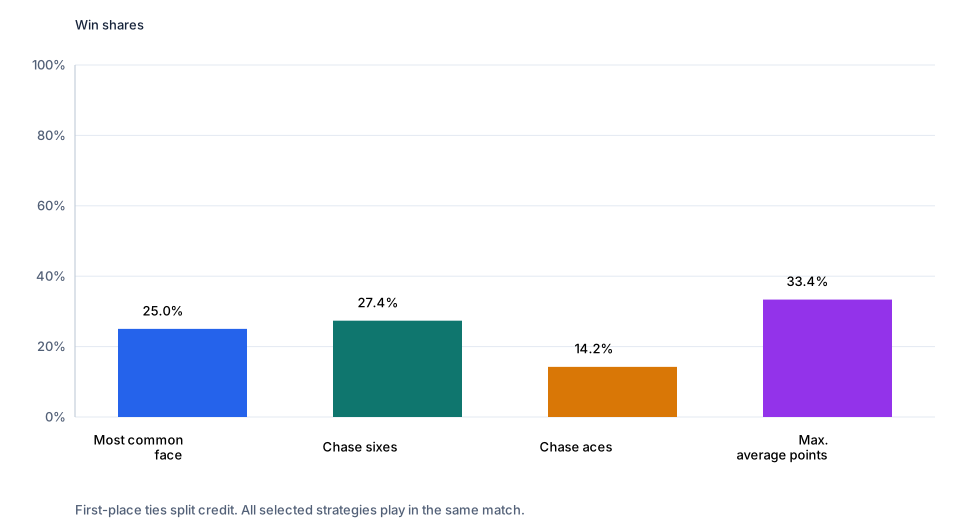
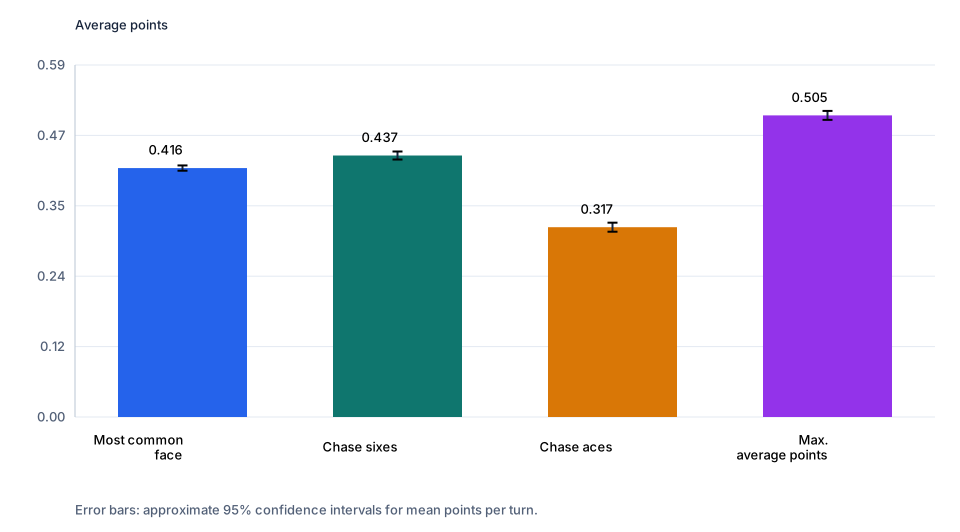
The lab combines exact dynamic programming with seeded match simulations, a graphical interface and comparisons against learned agents. The charts below come from a fixed four-strategy sample of 10,000 matches.
Count the ties properly
Win share gives fractional credit when players finish jointly first. Outright wins count only a sole winner. Keeping both makes it possible to see when a policy is collecting lots of shared wins rather than winning more often on its own.
The same distinction matters when comparing a learned policy with an exact strategy. The rules, opponent and objective need to match before the percentages mean much.
 View larger ↗
Under the hood
An exact dynamic-programming core and seeded Monte Carlo comparisons.
A graphical interface, terminal tools, uncertainty intervals and written mathematical guides.
Playing for a share of first place and playing for an outright win lead to different policies. The comparisons keep ties visible so that difference does not disappear into one headline number.